
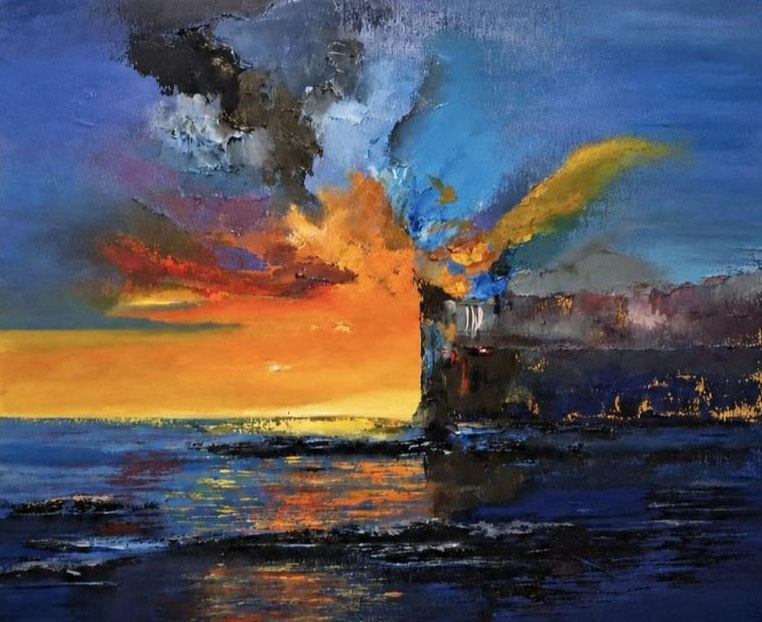
This interview was conducted in Spanish over Instagram Messenger in mid-July 2026.
William Pate, San Antonio Review: Tell us a little about yourself — where you’re from and how art became part of your life.
Leticia Torres: My name is Leticia Torres. I’m 56, and I was born in the department of Colonia, Uruguay. I’ve lived in Montevideo since I was very young, and I currently live with my two children, Enzo and Julieta, and my animals: Mila (a cat) and Rita and Renata (my dogs). I’ve always loved art in general and anything related to creativity. As a child, I only studied ballet. My father was a very cultured man, addicted to books, and he always gave me art and painting books as gifts. I loved drawing but never studied it. I think that’s where it all began.

SAR: When did you start painting? Was there a specific moment, or was it gradual?
LT: I started painting seven years ago. In 2019, I was diagnosed with breast cancer and spent two years in oncological treatment. Unable to work, with a pandemic on top of it, painting saved me. I hadn’t drawn since high school — between working twelve-hour shifts as a nurse, the house and my children, there was no time. The pause the illness forced on my life gave me time I’d never had, and the need to reconnect with what made me happiest: painting. It was my therapy. Just as I was finishing my oncological treatment, my husband was diagnosed with terminal cancer. He passed away two years ago. That’s when I threw myself fully into painting — I studied in several workshops and also took up cooking, pastry (another passion) and swimming. I filled my time with everything I’d always loved and dreamed of, and today they’re all part of my daily life.
SAR: What subjects or motifs do you find yourself returning to again and again?
LT: My work is varied. I like all techniques, and I keep trying to explore each one.


SAR: What techniques or materials do you work with most often, and what draws you to them?
LT: I work with oil, pastel chalk, pastel pencil, graphite, charcoal and acrylic. But my favorite is oil applied with a palette knife.
SAR: Where does your inspiration come from — other artists, places, memory, something else?
LT: I love taking photographs — seas, flowers, landscapes. Nature is my inspiration.


SAR: How has your work changed since you first started?
LT: I think I’ve kept improving since I started painting. I have more technical knowledge now when it comes to executing a piece: how to choose my materials, the pencil I draw with, the canvas, the oils… and how to build a color palette, a fundamental step for any artist, because it says everything about the painting. I’ve taken seminars and kept reading to keep learning.
SAR: Is there a piece you consider a turning point in your practice?
LT: My first oil painting, of my cat Mila. That’s when I knew I really was capable of painting. Sometimes you dream of something, but when I saw the finished piece and realized it truly looked like my cat, I said, “Yes, I can do this.”


SAR: How does being from Uruguay shape what you make, if at all?
LT: I don’t think being Uruguayan has influenced me in any particular way. What’s influenced me are the things I’ve had to live through.
SAR: What does a typical day in the studio look like for you?
LT: My day in the studio is the best day: the canvas, the brushes, the oil paint and me. A day of connection, of relaxation. The mind lets go of problems, anxieties and worries. It’s pure magic and total happiness.
SAR: When you’re working on a piece, is there something technical or artistic you’re still trying to master — a challenge you haven’t fully solved yet?
LT: The world of painting is infinite; it’s a continuous learning experience. I’d like to master hyperrealism more — it’s a highly precise technique, one of patience, detail and a lot of practice. I was able to take some seminars with Milani, a Brazilian painter who teaches his hyperrealism technique. But I still have a long way to go before I can master it. Seminars are expensive, so I haven’t been able to attend all the ones I’d like. I’m currently studying painting with an Uruguayan painter, Horacio Fabri.


SAR: What do you hope someone feels when they stand in front of one of your paintings?
LT: My paintings are generally very colorful and joyful — that’s what I try to convey.
SAR: What are you working on now?
LT: Right now, I’m painting a piece based on Edgar Degas, a French painter, because in my workshop we’re studying him, and to understand his work, we recreate one of his pieces and try to feel the way he did.
SAR: Where can readers see more of your work — on a website, in a gallery, or at an upcoming show?
LT: I don’t exhibit much because the costs in Uruguay are very high. Sometimes my workshop puts together a group show at the end of the year. I’d like to emphasize that in this country, studying art is very difficult, and making a living from it is possible for only a very few. As you’ve seen, living here is expensive, salaries are low, and painting is sometimes a luxury. Materials are expensive, and courses are even more so. Society doesn’t buy paintings — people can’t afford them. You receive many invitations to exhibit, but they’re very costly. I recently got an invitation to show in Punta del Este for three days in January. The booth alone costs US$1,500, and, on top of that, you have to rent the space for those days. Since it’s high season, the price goes through the roof.
View more of Leticia Torres’ work on her Instagram page, @leti_pinturas.


