
I am lazy. I am also stubborn. I suppose laziness is at bottom a species of stubbornness. Each trait by itself causes certain kinds of trouble, but teamed up, they render me nearly unbudgeable. These traits manifest themselves in many ways, but especially when it comes to taking care of my yard. I always hated yard work when I was a kid. I attributed this hatred to various allergies. Every time I rolled around on the grass, I got hives. Maybe I was allergic to working in the Maryland heat and humidity. As often as I could convince my father, who was a dynamo, that I had too much homework or was too wiped out from football practice, I knew I could depend upon his soft heart and his Calabrian work ethic to kick in, and he would mow the lawn himself. The Calabrian work ethic is different from the Protestant work ethic in that the Calabrese—that is, Southern Italian peasants—have no illusions of work bringing rewards or advancements, let alone a cushy afterlife. Work must be done simply to ward off wrack and ruin. I, however, am in the habit of putting off work till I’m feeling the wrack but not yet stuck with the ruin.
What’s funny is that now that I am 72 and retired, I find myself doing more yard work than I have ever done in my life. This is mostly because the HSA of the development where I live has a few standards they are apt to enforce with, say, a lien against your property. Of much less consequence to me is the Keeping-Up-With-the-Joneses ethos gripping most suburbanites. I could flatter myself that my unkempt yard is making a progressive political statement in a reactionary landscape of shorn and edged lawns, but who would I be kidding?
So, I submit to doing yard work. Nothing fancy or ambitious, though, like landscaping. Just the basics of weeding dandelions, wild carrot, and sticky weed, clearing out uninvited trash trees and shrubs, and mowing. I still get itchy, but I’m used to it now. My wife Dee does the serious gardening, with a little plot of herbs in front and some in pots, and a bigger plot in back for chard, broccoli, and other greens. She’s got a mandarin orange and even a pineapple in pots, and a T-Rex of the plant world, an artichoke, rearing up in the middle of our front yard. That is, Dee does the real yard work. I just keep cutting back the wrack and putting off the ruin, mowing being the main task. But not the kind of mowing you’re thinking of.
Years ago, I replaced my old gas mower with a push mower. No dealing with gas cans and fumes, almost no noise. And a little more exercise than I was getting with the gas mower. In other words, I could flatter myself that I was making virtuous choices. The only problem has been that if I wait too long to mow, which, being lazy, I often do, the push mower flattens and rides over the longer grasses without catching them in the spinning blades, and then I have to pass over the same spots again, but from different directions. That usually works, but takes twice as long as the gas mower did.
This has been an El Niño year, and here in Central Texas, that has usually meant early summer rain, much more frequent than in other years when spring and summer rains hardly come at all. Our little suburban yard is pleasantly green now, rather than brown and withered, but the rains and my laziness have meant that the grass has gotten too long for the push mower. My stubbornness (and miserliness, the third of a trifecta of personal quirks) keeps me from hiring a lawn service or a local teenager to do what I am perfectly capable of doing, if I’d just get off my ass and do it.
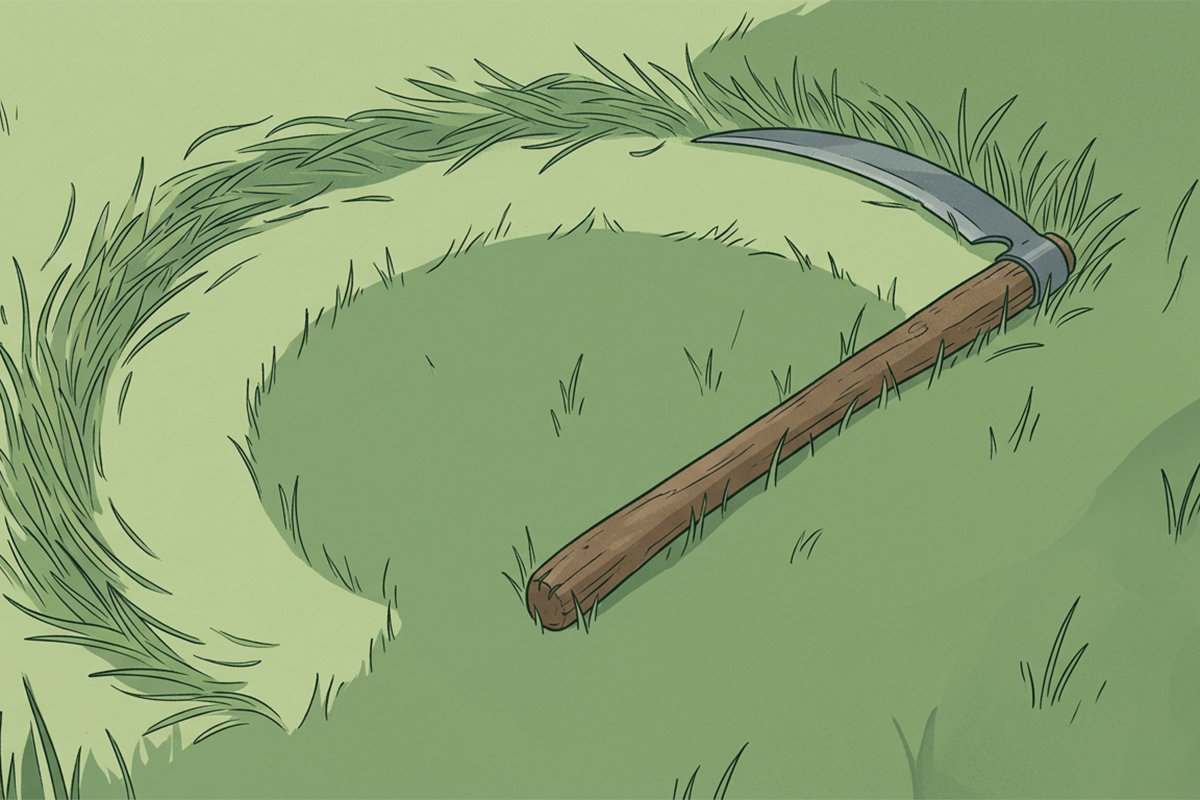
Yet mowed it must be, and so I resort to my scythes. These aren’t the proper scary Father Time scythes of my Calabrian ancestors. They are actually sling blades, but I like to think of them as scythes, albeit stunted. One, made by Ames, is essentially a lightweight weed whacker shaped like a crooked capital L. The nine-inch blade is double-edged, the slender wooden shaft is about three feet long, and you can work it with just one hand. An old neighbor years ago saw me whacking away and said, “Oh, you’re playing Mexican golf.” I didn’t laugh, and you shouldn’t either. The other, a Craftsman, has a similar shape, but its double-edged blade is a foot long, and the stouter shaft is about four feet long. When it comes to long, thick grass, this is the only one of the two that will do. (If “sling blade” has made you think of the intense, sad movie of that name and its featured murder weapon, it may also have occurred to you that a gas-powered lawn mower is basically a motorized sling blade.)
I am no grass expert, but I think we mostly have Bermuda grass with clumps of wiregrass here and there, especially near bushes and planters. The wiregrass must have been planted along with a few surviving clumps of monkey grass as ornamentals in the late 1970s, before I owned this place. In a yard where all sorts of plants spring up uninvited, I see no call for planting anything myself, least of all ornamentals. When it’s tall and thick, the Bermuda is more resistant to cutting and takes the biggest effort to mow. On the other hand, the wiregrass doesn’t resist the blade so much as slide under it, unless the blade is sharp.
Using two hands, I can indeed swing it like a gringo golf club, right to left, against the thickest patches. But I can also swing it one-handed like a pendulum against sparser patches. I let the grass stay where it falls, to mulch. It takes me two or three days to mow by hand: one for the front and one or two for the slightly bigger backyard. I know what you’re thinking: so inefficient. And you’re right. But that doesn’t matter so much to me, especially since retiring. Like when I go for walks, it gives me the time to think about things, though you do have to be a little more mindful swinging, or slinging, a sharp blade around (especially if, like me, you’re on blood thinners).
The first morning, for instance, being a former English professor, I thought of Andrew Marvell’s “Mower Poems,” a little suite he composed in the 1650s during a tutoring gig for the rich and famous in rural Yorkshire. The first of the suite, “Damon the Mower,” is what came to me first since in it Damon cuts himself with his own scythe (“by the Mower mown”). What are the chances? Well, he was letting his attention wander over to that comely shepherdess in the neighboring field. And now that I was thinking about Marvell, and how we share a birthday, and why he, who had probably not done a lick of manual labor in his life, came to be interested in these field workers, I found myself wondering whether I could somehow mow myself down, too. Did watching a rag-tag mower make Marvell, in his clean white linen shirt, take his eye off the ball, his young charge he was teaching French and Italian, basically grooming for marriage to a man even richer and more powerful than her daddy? Was that why Marvell was eventually dismissed?
Formerly my own work outfit, unlike Marvell’s puritanical get-up, consisted of what used to be called a “sports coat” and a bowtie. Now that I’m retired, my yardwork outfit is accessorized by gloves, sunglasses and a dark blue gimme cap gifted to me by my father-in-law many years ago. It reads “ROCKLAND COUNTY SEWER DIST.,” a facility he used to help maintain on the west side of the Hudson. Raul (Junior to his siblings, Doc to Dee, and el Jefe to me) was a scientist specializing in water systems, and along with teaching at several universities in and around New York City, he moonlighted by conducting environmental impact studies that helped clean up the river. He was a lovely man with a sly wit, and I believe he was reasonably fond of me. I like to think that his gimme-cap gift was a way of saying, “For my daughter’s sake, I like you well enough, but you’re still a shit-head.” A very perceptive man, that Raul.
Ages ago, I dragged Dee and our baby daughter up to that estate in Yorkshire only to find the owner wasn’t congenial to trespassers, even relatively harmless Andrew Marvell nerds. We drove as close as we could to Ryther, the nearest hamlet, got out, and tried to catch sight of the property from there. A homeowner saw us, stopped mowing his lawn (with a modern gas mower), introduced himself as Mr. Daniel Dry, and asked us if we were lost. When we explained what we were doing, he bade us follow him into his garage, where he laid out an ordnance map of the area and pointed out a trail starting out right by his property that could take us into the fields. “People have been freely walking these trails for thousands of years, and I don’t approve of landowners making them off-limits.” We thanked him and set off on a narrow path through a field of barley with our daughter asleep on my back, heading down to a river that ran through the fields Marvell’s mower had mown. There was the great house, there the yews, trimmed into giant golden and green billiard balls, there the brick terrace wall Marvell had stepped down from to enter the fields, there some grazing sheep, but no shepherdess and no mower.
After taking several pictures, we headed back up the path to our little rental car, strapped Clem into her baby seat and ourselves into ours, when suddenly Dee and then I started itching. Slender little bugs were wriggling over our hands and arms and legs, barley flies we later learned, harmless but alarming. We jumped out of the car, wiped as many of them as we could off of each other, and then sped away from the aptly named Ryther. Clem slept through it all.
Here and now in Central Texas, it’s mosquitoes. Hot as it is, I wear long blue jeans and a long-sleeve shirt and spray environmentally-friendly bug juice on my wrists, ankles, neck, ears, and a tear over my left knee. I can hear the high, faint drone now and then, but the spray seems to work. I don’t know what my Dad and uncles did when they mowed their father’s field. Lather up with kerosene? And Damon? What old folk remedy did he have against those wriggly bugs? Were mosquitoes there in 17th-Century Yorkshire? Marvell doesn’t say. They were in Calabria, along with the malaria that for centuries drove Calabrese to flee, if they had the means, which few did. Texas mosquitoes don’t carry malaria, so far as I know, but they do carry West Nile virus. Note to self: get a lot more bug repellent.
On the second day, I can tell my blades are dulling, and I make another mental note to look up a YouTube video on how to use files to sharpen them. My Dad probably had a whetstone in his pocket. Damon had a strickle, a flat piece of wood he would coat with sheep or pig grease and then dip into a sack of stone grit, resulting in a primitive kind of file he could then swipe along his scythe blade.
Before going about her business, Dee always checks to make sure I’ve taken my morning pills, have my phone with me, have the ringer turned on, and also have a big container of cold water, which she’ll bring me if I’ve forgotten. Every once in a while, I will pause for a drink, but I probably don’t drink as much as I should, a habit I picked up from high school and college summer football camps. Our coaches seldom gave us breaks, and when they did, they always warned us not to drink too much: “Don’t die on that water!” Odd, since it was more likely that we’d die from not drinking enough. I noted that the World Cup soccer matches going on now all include one “hydration break” in each half. If he were still alive, one of my old coaches would say, “Those soccer boys are weak sisters.” I laughed the first time I heard that, but I wouldn’t laugh now, and neither should you.
I remember my dad telling me about how, during the Depression, he and his two older brothers used real honest-to-goodness scythes to mow their fields. My Aunt Angie, their younger sister, remembers the boys taking turns mowing with a new-fangled gas mower. Which account is true? Perhaps both are, the new technology replacing the old at some point. The new house their father had built stood about one hundred yards from a chimney, open well, and root cellar, all that remained of Clean Drinking Manor, built in 1699 and rebuilt in 1752. They had to work around these ruins, as well as step over the groundhog holes dotting the property. Washington summers can be miserable, hot and humid. It must have been exhausting, no matter what contraption they used. One time, as my father was trudging back up to the tool shed, he found a copperhead he had unwittingly, and luckily, sliced in two. That story has more edginess if you imagine him swinging that scythe, doesn’t it? I wear shoes. I wonder if my father mowed barefoot. Damon probably wore wooden clogs.
We get snakes in our yard (rattlers, coral snakes, rat snakes), but I try to make a little noise before I get started, and they’re all likelier to scoot than lie in wait. Any sling of the blade is liable to reveal a benign curiosity. A few toy kitchen implements or a tiny plastic turkey drumstick, remnants of my daughter’s playhouse that once stood where I’ve now stacked cordwood for our fireplace. None of that today. Instead, the blade discovers a tattered piece of armadillo shell, its ochre plates flecked with gray wedges. I don’t see a skeleton, so maybe just this part had been dragged into the yard by a coyote. Coyotes come up along the dry arroyo about thirty feet down from the edge of our property. Armadillos like to burrow up under the deck behind our bedroom. They have terrible eyesight, which must make them easy prey. Years ago, Dee and I stood still here as four baby ‘dillos wandered fearlessly about till every so often bumping up against our ankles and backing away in surprise. Neighbors don’t like them and kill them because they dig for grubs under the lawn. A divot here and there doesn’t rankle us. But it reminds me of my grandfather Pasquale shooting groundhogs. He had left Calabria nearly penniless in 1914, but three decades later he was a New World padrone, who owned and rode a horse, Roxanne, and feared she’d step in a hole and break a leg.
Damon doesn’t have a horse and walks home in the dark, lit only by glowworms, a different kind of bug from our fireflies. He’s left the shepherdess love tokens, oak leaves, lizards, a snake he somehow de-fangs (a “curb sandwich?”), but then is bummed because she sees them just as the usual stuff you find in the fields, not as love-tokens, though the messed-up snake probably got her attention. Can we blame her? He does. Damon is the sensitive sort. And now he’s baffled as he retires to his hovel.
Other than the chuh the blade makes as I cut the next portion, it’s pretty quiet here. If she lets him out on their little deck, our long-time next-door neighbor Pilar’s dog Zippy will yap at me for a while till he gets bored. On the other side, the owners have been away for a few months while a second story has been added. They are the fourth occupants during the forty years I have lived here. In former days, I would find and toss back the occasional hardball or tennis ball that different kids had hit or thrown over the cedar privacy fence. This crew is the first who haven’t bothered to introduce themselves. Hunters. Teens who’ve outgrown ball games. Big pick-up trucks and a lean and hungry look.
On this third day, I am feeling my age. I’ve been drinking water more, and I can feel the difference almost immediately. A little more steadiness. But even under the shade of our writhing live oaks, it wilts away fast in this sticky heat. Like a duffer with an awkward swing, I now and then gouge out a divot. A few times, when using just my right hand to swing the blade like a pendulum, I’ve lost my grip. It’s heavy, so it doesn’t go flying. It just drops to the ground. But it’s another disappointment, another little setback for this seven-decade-old body and my stiff, tingling fingers.
A step down toward the arroyo is a patch I don’t mow, at least not today. It’s overgrown with Virginia Creeper and maybe some poison ivy, which turns me into a leper. It’s our little pet graveyard, too, so I’ll have to deal with it someday. It holds a bearded dragon, our dog Skittles, and a few cats, especially our favorite, Monster, who got not only a flat covering stone like all the others, but also a headstone with his name carved on it. I dug all those little holes and tucked them into boxes or blankets. Et in Arcadia ego. Death speaks Latin, once a universal language. Marvell knew what it meant. My father didn’t. I do. Death says, “I too am here in Happy Valley.” Damon doesn’t know Latin, though Marvell has let him feel its import in his bones: “Death thou art a mower too.”
When we were first engaged, I took Dee back east to meet my family. My grandfather Pasquale had died a few years before, but I wanted my bride-to-be to see the old Altimont family home. My Dad warned us that a developer had started work on the property, and he didn’t know what we would find there, but that warning did little to lessen my shock and disappointment. No trace of Clean Drinking Manor remained. No trace of the house my grandfather had built remained. An asphalt road snaked through what had been fields and the freshly dug foundation pits of what would be new homes. I tried to describe what I had wanted Dee to see for herself. An immigrant’s vision of a house a well-to-do Calabrian would have built in the old country. A red tile roof. White stucco walls, A big verandah that seemed to float on a sea of azaleas my grandmother had planted. A patio shaded by grapevines. A duck pond. A vegetable garden. Fruit trees. A little stable that hadn’t housed a horse in decades. Nothing there other than what my poor words could conjure. But we had our new life together, and our own home and little plot of land waiting for our return.
Grass doesn’t grow in the wild, lower corner of the yard. Sumacs and chinaberries and Lord knows what else have taken over, what with all the rains. Somewhere in there, where our daughter’s trampoline once stood, is a beautyberry we actually planted. Somewhere in there are bird peppers I used to harvest. I tell myself I’ll get around to clearing out the trash trees and brush before too long, more work for the bigger sling blade. It’s going to take a lot more mosquito repellent to get through that mess. Anyway, there is another bird pepper bush under one of our live oaks I don’t have to carve a path through a jungle to get to. And the mowing, for now, is finally done.
A couple of days later, after the soreness has passed, Dee and I head to Galveston for a family reunion. Not as many people show up this time, but the weather is good, the water nice, and we get to talk with cousins and their kids we haven’t seen for some time. Cousin Peggy, dying of cancer, accepts our well-wishes but doesn’t want visitors. The same with Aunt Senie, who has her own ailments. Before driving back to Austin, we buy a gallon of water, a dozen roses, a bundle of washcloths, and a little garden rake at a monstrous Walmart, and visit Dee’s grandparents and aunts and uncles at the Catholic cemetery. It always takes us a little while to find them in a newer section where the stones are all flush with the ground to make mowing easier. We pull weeds and wash off sandy seaside dirt from the stones. The names come clear: Clementina and Raul, Carmen, Hugo, José, and Sandie. Dee shares some of their stories with cousin Senya and Patrick and their kids, Katya and Cross. We warn the kids about stirring up fire ants and stepping on sticker-burrs. Cross, the younger of the two, is very particular about how he distributes and arranges the roses, which pleases me, though I can’t quite say why. Dee and I drive home early the next day past the tangle of Houston highways and, eventually, mown fields and machine-rolled hay bales cowled in black plastic.
Now that I’m done mowing for a while, I can get back to being lazy, sitting down at my keyboard, writing this essay, adding some verbal ornaments, trimming phrases that are longer than they ought to be, and making it presentable. Like a lawn with no unpleasant surprises, a lawn someone wouldn’t mind walking over barefoot.


