
She hated the Sunday dress her mother had picked out for her at the Northwood Mervyn’s, which had a thousand such dispiriting dresses for sale. Floral print with long sleeves, fussy collar, and a hem four inches below her knees. Carolina had chosen it back in the fall during a phase when she was especially devoted to Roundstone and to Pastor Mike, practically in love with him, in fact, even if Pastor Mike didn’t know who she was back then.
Lina had to wear the dress to church every Sunday with stupid white pantyhose and hideous Payless shoes. Her mother had told her that she looked “distressingly beautiful” in this monstrous outfit.
Just who am I distressing, she thought. No one. Except me.
Roger believed that driving his plumber truck to church on Sundays was good for business. “Free advertising! Look and see how many trades park their trucks at Roundstone on a Sunday!”
Her mother’s Datsun was still busted, so they had no choice. In the truck, on Sundays, she always had to sit in the middle because her mama always had to have the window seat on account of sitting in the middle; she insisted it made her car sick.
“Truck sick, you mean,” Lina remarked.
“It just happens, Lina, I can’t help it. You don’t want me sickin’ up on you, believe me. Though you sure did sick-up on me when you was little!”
Back in the fall, before the episodes and the new meds and ECT procedures, Carolina would be aglow with excitement on Sunday mornings on the way to Roundstone. “Going to hear the word of God! Makes me all goosey!” she’d say, hugging Lina, squeezing her hand, kissing her fingertips.
Children love their mother’s love, don’t they? Only, once you are fifteen, sometimes you don’t. Not in public. Not in front of your mother’s husband, Roger the plumber man.
They still went to Roundstone every Sunday, only it wasn’t quite the same because Carolina hadn’t been quite the same enthusiastic fundamentalist evangelical since her wandering-Ferndale-Street-in-her-nightgown episode, and her adulterers-consuming-the-innocent shout-out at Roundstone. Since she had started seeing Dr. Shapiro and been prescribed Zyprexa, amitriptyline, and ECT. She was slower than before, and Lina thought she had lost some of her self-confidence. She kept saying she had lost her looks even though she really hadn’t. She had put on a couple of pounds. She did seem physically weaker and super-sensitive. Climbing up into the big, burly plumber truck in her going-to-church dress sometimes seemed difficult for her.
When Roger had suggested they both start taking walks for exercise and weight-loss, she had gotten all weepy because she took it as meaning she was getting fat and Roger was going to leave her.
And sometimes she went all silent and disconnected like she had fallen in on herself. Like an old house failing and falling in on itself, the walls and everything the walls had contained—memories, furniture, individual rooms—collapsing into a dusty demo-pile of rubble, lead pipes and lathing.
A wrecked house.
What a mean way to think of your own mother.
Only it was true that the meds, or maybe the ECT, or more likely both, had slowed her down, taken the edge off her East Texas/Cajun/red dirt-girl smarts and sass that used to cut through conversations and situations with zing and bite.
Carolina’s granddaddy was a sharecropper. Her mama died when Carolina was a girl, and sometime after she left home, her daddy had driven himself off a bridge into the Sabine River. Raised in poverty, she had made a life for herself and had no time for fools. Only now her sentences came out slowly, words swimming in syrup and sometimes getting stuck. Sometimes Lina found herself waiting for her mama to finish a sentence, only to realize that sentence had been abandoned long ago.
In some ways, however, Sundays were still the same. They still drove to Roundstone in the plumber truck. She still had to sit in the middle with Roger’s blunt hand resting on the gearshift knob, practically on her knee. After the service, he and Carolina would go home, and she would stay for YM, then take the bus home. JJ took the same bus. They never sat together.
There was a big electric sign at the entrance to the parking lot.
The Roundstone Church & Community / Making it hard to go to Hell from Texas
Roger cruised up and down rows of cars and trucks glittering in the heat until he’d located a parking spot where he figured enough people might see and take note of the Can-Do Plumbing truck.
They all got out, and Roger stood with his shoulders pulled back, looking toward the church steeple away on the other side of what was called the campus. Sundays at Roundstone still made Roger anxious, though he had been a member of the church for years, since before they met him. He still couldn’t quite believe that he was good enough or established enough to be a member of such a big, rich, impressive mega-church. He still couldn’t accept that he had been invited to the party.
Carolina placed her hand on the small of Roger’s back. “Come, O Spirit,” she said.
From the Pentecostal hymn.
“And dwell among us!” Roger said, and his posture relaxed.
Sometimes he tried to behave as if he were the boss of her and her mother, but it wasn’t so. Only, things were changing. Since the procedures, her mother had seemed to be depending on him more and more. Today, however, Carolina actually did seem better. Brighter. Stronger. Maybe the negative side effects of ECT and anesthesia were wearing off, and only the positives would remain.
And there had been no talking airplanes except, maybe, yesterday afternoon in the kitchen.
“Here’s the Preacher,” Roger said, and Lina watched the Calhouns’ Volvo station wagon cruise slowly down the row of parked vehicles.
“A man of principle, a follower of the true Christ,” Pastor Mike proclaimed back in January, introducing Preacher Daniel Calhoun to the congregation. That had been Preacher Dan’s first and so far only appearance up on stage on a Sunday. And Pastor Mike had said the same thing about every new preacher, and usually fired them within six months, though some had quit.
“Pastor Mike is a powerful, bright light!” Roger would tell anyone who dared say anything that came within a hundred miles of criticizing his church or his Pastor. “These backwoods preachers take their energy from him, learn everything from his ministry, then leave him for greener pastures.”
The Calhouns’ Volvo was turning into one of the parking spots posted Reserved for Clergy.
Those California plates. LA’s no backwoods. Wrong again, Roger.
“Come now, Lina,” her mother called, her voice sounding stretched and thin, like a worn-out piece of clothing that was all about the past, the rough things that had been done to it, the care not taken.
Eliza Calhoun, getting out of the Volvo, saw Lina and waved. The girls were spilling out of the backseat, and Lina gave them all a little wave, then made herself turn away and start after her mother and Roger.
The Roundstone campus had several ugly, boxy, beige-colored buildings set around a wide lawn crisscrossed with cement paths. Most people were streaming toward the largest building, which was the church. Wives and daughters in Sunday dresses. Fathers and sons in best jeans or khakis, nice shoes or polished boots, shirts with buttons. No T-shirts allowed. No shorts. No halter tops.
Awake was one word for the atmosphere. Charged.
Anticipatory—there’s a word. The congregation expected a lively show, and Pastor Mike would deliver. They could count on him for that.
Every building on the campus was identified by a wooden sign out front. The Sanctuary. Roundstone School. Thurston Library of Christian Works. Colorful, ugly vinyl banners flapped from buildings, proclaiming All Are Welcome Here Todos Son Bienvenidos Aquí. Rejoice in the Lord Always.
The grass at Roundstone was like something that had been purchased and unrolled, like a carpet, not a thing of nature. The LED marquee outside the church flashed.
PASTOR MIKE JOHNSON SERMON TODAY! WE STAND WITH ISRAEL
Hundreds of eager people in their Sunday clothes were sweating, panting, and pushing to get inside the air-conditioning. Sullen teens, red-faced dads, frail grandmas, exhausted moms. White folks, mostly. Maybe twenty-five percent of Hispanics. Several black women wearing gorgeous dresses, accompanied by their beautifully dressed children. Everyone talking, hardly anyone listening.
Here I am, she thought, here I am, and how did I come to be?
Roger was steering her mother past the security people in their peach-colored blazers who were on the lookout for lunatics. Lunatics with guns. Pastor Mike was a passionate man, and “Fire draws fire,” Roger said. People who hated Jesus hated Pastor Mike Johnson, apparently. People who did not wish to be saved. Who were on a straight trip to Hell. Devils and devilish. Devotees of Satan himself. Acolytes of Bill Clinton and his devious she-devil wife.
Roundstone people claimed their church was the biggest room in the city. The Alamodome was bigger, but it was a stadium, so it didn’t count. The year before, Billy Graham, nearly 80 years old, had preached four nights in a row at the Alamodome to a quarter-million people all told. San Antonio was Pastor Mike Johnson’s home turf, but he had not been invited to preach alongside Rev. Graham, which was an insult, Roundstone people told each other.
Lina stayed close to her mother and Roger as they started up the aisle, heading for their seats, for which Roger had been tithed several hundred dollars. When they reached their row, he went in first, leading Carolina by the hand and muttering, “Excuse me, excuse me” as they bumped their way past people’s knees. Lina squeezed in after them. Aisle seats cost more. Nearer the stage costs a lot more. It took money to get really close to Jesus.
Lina spotted several kids she knew from school, including Becky, which was a surprise. Becky had hardly shown up at Roundstone when her parents were still members of the congregation, and they had recently quit to join a smaller evangelical church.
Becky Gutierrez and JJ Williamson were settling into the seats that belonged to JJ’s mom, who was nowhere in sight. When he was there with his mom, JJ always wore a button shirt, but today it looked like he had on one of his grungy old concert t-shirts, totally against the dress code. Maybe he thought wearing the t-shirt would impress Becky, who had always been an outlaw.
Back in elementary school, Becky had been very Christian, praying so intensely that even her very Christian parents worried about her. She’d told Lina that she used to lock herself in her room to pray nonstop. Then she spent three years in Zambia with her parents, who were both veterinarians and went to Africa as missionaries to spread the Word of the Lord and help cattle herders care for their animals. Becky had started hanging out with village kids, gotten into Zambian music, and even, she claimed, run away once to Nairobi, Kenya. She had returned to Texas a committed atheist, but here she was in Roundstone, on Sunday, whispering in JJ’s ear and touching his skinny bare arm. And JJ was turning to her and smiling.
Had Becky found her way back to Jesus? Were the two of them on some kind of weird evangelical date? Kids in high school went crazy in various ways. Jake said that, even at Edison, his semi-suburban school, there were psychotics, autistics, anorexics, kids raped by Satan, and a girl who cut her own forearms with a Leatherman knife—little slashes that scarred up, and that she now seemed to be proud of. Early in the spring, a boy had been arrested in the middle of Jake’s Pre-Calculus class and made to lie on the floor between rows of desks with a hefty sheriff’s deputy kneeling on his back, zipping plastic flexcuffs tight on his wrists as the kid bucked and howled.
At twenty-three, Bonnie Parker was not that much older than being a teenager when the posse killed her in Louisiana. Growing up in West Texas, Grandma Charlene had heard plenty of legends about Bonnie and Clyde. She said that country people remembered the outlaws because they had been country people themselves, even though their families lived in West Dallas, which in those Dust Bowl days was nothing but a slum for poor sharecroppers blown off the land. “The real Bonnie Parker never shot anyone. She was just a little waitress who got herself into bad company. She was terrified of guns.”
The biggest room in the city was filling up. Lina scanned the stage. Would Daniel Calhoun ever be invited to preach to the congregation and the TV cameras on a Sunday? Sunday was the Big Time at Roundstone, Sunday was Game-of-the-Week, with the church packed full and the cameras and the lights, but Pastor Mike loved his Sunday pulpit and wasn’t much into sharing. How long would the Calhouns last at Roundstone? Would they last the long, steamy San Antonio summer—or flee back to California and blue-water beaches, surfing breaks, and gray whales? Some preachers, like Brother Jed, had come and gone at Roundstone without ever being invited to preach on Sunday. They were, of course, kept busy with other duties: preachers had to earn their keep. She knew that Preacher Dan, aside from teaching Sunday Youth Ministry, was also responsible for Prison Outreach at Dominguez Jail and the Juvenile Detention Center, and also a ministry with older adults at The Meadows, and another at Christian Village. Not exactly the glitter train.
It was getting close to showtime, and the biggest room in the city was abuzz with 2,500 people talking, greeting, smiling. Nobody was praying that she could see.
Taking her mother’s Bible, she started to leaf through Ecclesiastes, hunting for a verse to argue in YM, the last YM of the school year. Many Roundstone teens were heading off to Bible summer camps and missions, some as far away as Korea. Preacher Dan didn’t mind kids in class arguing with him and questioning what he said the Bible said. This was unusual. He even seemed to enjoy arguing, and she had never before encountered a preacher or teacher—or anyone, really—who seemed to enjoy arguing as much as she did. Carolina, even when she was well, could not handle any sort of disagreement and inevitably ended up in tears, screaming, or both. Roger—forget it. Her father always shied away from arguing; maybe he’d had too much of it growing up. Grandma Charlene had plenty of strong opinions that might even be called vehement.
Most high school teachers did not appreciate students who argued. Arguing was talking back—a waste of time, rude, disrespectful. Arguing could get you in trouble.
Maybe it was the Fitzhugh in her that liked to argue and to question. We are a disputatious family.
Scanning the seats below, she spotted Eliza Calhoun and her three daughters seated several rows back from the stage and to the left. Preacher Dan usually sat with his family, but wasn’t with them today. The two little girls wore nice, unfussy dresses. Possibly homemade? Their mother must have brushed their hair, tied their bows. They were probably both wearing party shoes.
The oldest girl, Jennifer, wore jeans and what looked like the same t-shirt she’d had on the night before, and her hair wasn’t brushed. Major violation for a preacher’s child to come to church dressed that way, and amazing that her mom had allowed her to. Maybe after you lost a child, some arguments just weren’t worth it. And from what Lina could see, Jennifer was being just as calm and well-behaved as her sisters. All three of them would be accustomed to being in church and with lots of people watching them.
Lina located a verse in Ecclesiastes and then handed the Bible back to her mother, who kissed it. When it came to Scripture and Christianity in general, Carolina ran very hot or very cold. Her zeal was hard to predict. She had been raised a hardshell Baptist, with short, intense spells of Catholicism from her Cajun grandma on her mother’s side. When James Bowie Fitzhugh met Carolina Hart at the commune in New Mexico in the summer of 1981, she was a Buddhist witch.
Carolina’s unpredictable hotness or coldness on Christianity troubled Roger, who liked them to read Scripture to each other during the commercials while they watched their favorite shows. And for the past several weeks, Carolina had been somberly Christian. But that could change if the airplanes showed up.
Lights went dim, then brightened. Showtime. There was an expectant hush as Mercy’s mother, Pastor Mike’s wife, Scarlett Johnson, came out from backstage, followed by—surprise—Preacher Daniel Calhoun, wearing a handsome blue suit.
Only the second time in five months that Preacher Dan had been allowed to appear on the Sunday stage.
Mercy Johnson was nowhere to be seen. She had not shown up for a Sunday since Easter, even though she was the Pastor’s adopted daughter—Roundstone was supposed to be all about families worshipping together.
Long ago, Mercy told Lina that Pastor Mike had adopted her when she was too young to have any say, so she did not actually consider him to be in any way her father. “And him and my mother, they won’t stay married forever.”
Scarlett Johnson was wearing an extraordinary dress. Admit it, extraordinary. So unlike the plaintive, Little-House-on-the-Prairie Sunday dresses most other women were wearing, or Mrs. Calhoun’s straightforward teacherly style. Scarlett’s was powerful and confident in its clinging simplicity. A dress as a declaration, not decoration. Here I am, listen to me. She probably found it on one of her shopping trips to New York City or Paris, France. She always went alone, she went often, and she never took Mercy.
Carolina’s horrible church episode back in March had started with her accusing Roger of having an affair with Scarlett Johnson. “You love her, don’t you?” Carolina proclaimed all of a sudden, so loud that everyone seated around them heard.
It came out of nowhere, as far as Lina knew, though it was true that Roger did like to talk about how intelligent Pastor’s wife sounded.
“You’re a couple of love bunnies!” Carolina said, then lurched out into the aisle, heading for the stage, shouting about adulterers consuming the innocent.
Scarlett probably still didn’t know who Roger Cantu was—or only that he was the husband of the crazy lady.
Scarlett was now headed straight for the pulpit, leaving Preacher Dan lingering awkwardly on the brightly-lit stage as though he wasn’t sure where to stand or sit. Pastor Mike was nowhere in sight. His makeup was done by a professional, and he usually delayed his entrances until Scarlett had stoked up the congregation.
“Ain’t she pretty!” Roger whispered. “That’s one beautiful woman. She has the grace; she knows the Lord Our Savior. You can see the Blessing in her! Only God can create a beautiful woman!”
Lina saw her mother flinch. Sometimes, Roger was so dense.
Scarlett was Pastor Mike’s second wife. He’d buried his first in Oklahoma, Mercy said, before he hit the big time with his first regional cable deal. Actually, and despite the sleek dress, Scarlett this morning looked kind of… disorganized. Which was weird. Her hair looked… ratty. Mercy’s mom was usually about the most put-together, well-dressed, perfectly made-up professional woman in San Antonio.
Scarlett was leaning into the microphone. Her makeup, even from a distance, looked blurred, smeary. A sputter of static from the speakers, then, “In the name of our Savior, Jesus Christ,” Scarlett’s sexy, deep Sunday voice breathed into the mike, “welcome to Roundstone ministry and may God the Father bless you all.”
Then she stopped talking. There was only the buzz of the speakers. Standing at the pulpit, shifting her weight from one stiletto heel to the other, Mercy’s mother, usually so poised and self-possessed, appeared… restless? Disorganized. Unbalanced.
Scarlett Johnson had probably been better at almost everything than almost everyone else in her life all her life, and smart enough not to show it too much, but now, in front of two thousand five hundred eager, welcoming, loving Christian people, she was shifting from stiletto heel to stiletto heel and looking like no one so much as a woman very anxious to pee.
Maybe she was sick, poor thing.
Then Scarlett shook her head, seemed to steady herself, and offered the mike a throaty little chuckle. “Just after Christmas, just after… when was it? Christmas. Yes, Christmas. Jingle bells, jingle bells, jingle all the way.”
The level of fascination-slash-unease in the huge room was palpable. The entire congregation was holding its breath. Was the pastor’s wife… drunk? On Sunday morning? Could it be? Or high on something?
Holy moly.
“Just after the birth of Christ,” Scarlett whispered into the mike. Then repeated, “Just after the birth of Christ…”
She was stuck. Forgot her lines? But Lina could see her struggling to pull herself together—Scarlett Johnson was a pro, after all. “My husband had you welcome Preacher… Preacher”
Uh-oh. She’d run out of steam again. Had she really forgotten Preacher Daniel’s name? Could Roundstone’s First Lady really be delaminating before their eyes?
“Preacher Dan, Preacher Daniel Calhoun. Came to us from First Evangelical Free Church of Los Angeles, California. He has been spreading the Word of the Lord as our Youth and Outreach leader. Outreach is what it’s all about. And I’m to let y’all know that next Sunday Preacher Dan will get his own first opportunity to preach The Word from this very pulpit. Preacher Dan Calhoun!”
Turning to face the Preacher, she started clapping. The congregation got the message, and sporadic clapping became a thunderous roar of applause. Then Scarlett turned back to face the congregation, stumbled on one of her stilettos and grabbed hold of the pulpit to steady herself.
Where was Pastor? Still getting his makeup done?
Preacher Daniel was looking uncomfortable. Scarlett had bent over the microphone so that her lips were just about touching it. “He leads you in your thousands,” she murmured.
Okay. If Sunday was Game-of-the-Week, now it was time for kick-off, and Scarlett seemed to have found her way back to the script.
“You follow him because you know what he says is the truth. And the truth of Our Lord Jesus, who died for us.” She paused. “Who died for us. His message is received nationally and worldwide, he’s the author of twelve books, including a New York Times Bestseller—”
“And ain’t you the queen of the rodeo,” Carolina said aloud.
“Poor lady!” Roger whispered. “Someone ought to get up there and help her.”
“—my husband, chosen father of my child, watchful Shepherd of his flock, Your guide along the paths of the Lord, Pastor Mike Johnson.”
Waves of applause. A sea of applause. It was always the same, Sunday after Sunday. And there he was, Pastor Mike, strutting onstage, his bland, chubby face aglow with makeup.
“They never asked me,” Mercy told Lina. “I was nine. If they asked me if I wanted to be adopted,d I would have said, ‘No fucking way.’”
The pastor had a pink face and thinning blond hair. He was quite short. Whenever Lina saw him in action, meeting and greeting people after service, or being interviewed on TV, he was always bluff and friendly. A friendly salesman with a twinkle. Always seemed happy. People appreciate happiness. Roundstone people liked to say Pastor was a model; Pastor was his own best sermon; the peace of the Lord was in Pastor’s heart, which was why he radiated optimism and joy.
Scarlett and Preacher Daniel took seats stage left, facing the congregation, while Pastor Mike approached the pulpit and stood for a few moments, accepting their applause as tribute and smiling like a delighted child. Then he raised his right hand, and the room fell silent.
“Dear Lord.” Turning, he looked directly at Preacher Daniel, then turned back to the congregation. “We ask for Your anointing to flow through Preacher Daniel. May Your Holy Spirit empower his words and bring them to life. We pray that the message he shares will touch hearts, convict spirits, and lead us closer to You. May he speak with boldness, humility, and clarity, and may Your Word be received by all with open hearts. Bless Preacher Dan with the wisdom, strength, and courage needed to deliver Your message. As in Timothy, chapter four, verse two, may he preach the word and be ready in season and out of season to reprove, rebuke, and exhort, with complete patience and teaching. We pray that You empower Preacher Daniel, Lord, to speak Your truth with boldness. Amen.”
Scarlett was bent over, whispering in Preacher Daniel’s ear. Daniel seemed to be trying his best to listen to what she was saying while also listening to Pastor Mike, who had started talking about the Lifting Off for Jesus fundraising campaign.
“I have been accumulating my flying hours,” Pastor Mike was saying, “as all of us do, and must do. This is the way of the Lord. All the time aware that, for all of us, our days are surely numbered, our time is growing short!”
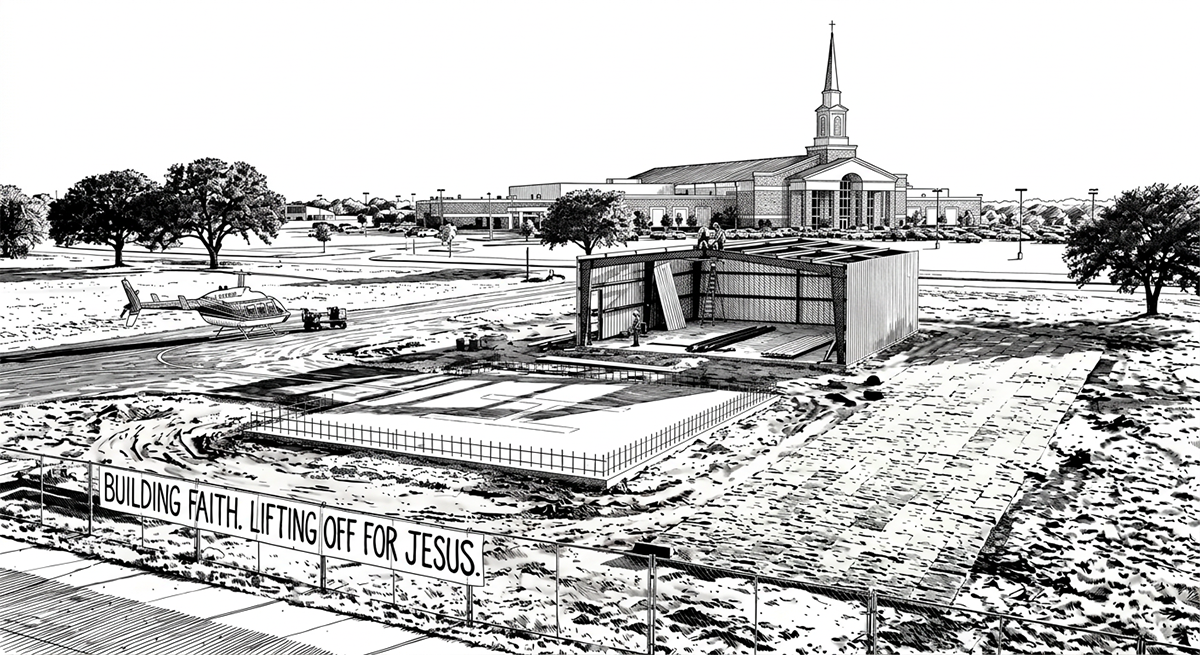
For the past year, the church had been tithing to fund the leasing of a Bell Jet Ranger helicopter and FAA-approved helicopter pilot training for Pastor Mike at a flight center in Georgia. A helipad, hangar, and maintenance shed were under construction on the Roundstone campus.
“But learning to fly the helicopter to master the whirlybird so that she is more an eagle than a turkey has taught your old Pastor a few things!” He paused for a response from the congregation. Several voices obliged.
“Not old!”
“Not you, Pastor!”
“Never old!”
“Spring chicken!”
People in the audience were laughing, and Pastor smiled and bowed his head in humble acknowledgment. Then he held up one hand, and the huge room again fell silent.
The Lesson was coming. Scarlett was actually leaning on Preacher Daniel, her eyes shut.
“Learning to fly a helicopter has taught me—for I hope I can still be taught, I can be instructed, hope that I keep forever within my heart that precious gift, the love of learning—the whole business of acquiring the skills to operate such a difficult, awkward machine has taught your old Pastor several scary—may I use that word, scary?—lessons.”
“Never scared!”
“Never! Never!”
“Fearless in Jesus!”
“Not you, Pastor Mike!”
“The helicopter,” Pastor Mike calmly continued, “has taught me powerful lessons about learning itself, about accepting and abiding by the rules of this life, this universe, as established by the powers and guided by the infinite wisdom of our Lord.
“For unlike the graceful airplane, you understand, the poor old heli has no plane to it. Not an ounce of planing in its nature. No effortless glide. On its own, this machine has as much glide to it as an adobe brick.”
Laughter from the congregation. People calling out.
“Save us, Pastor!”
“Keep us from crashing!”
“Crashing and burning!”
Several people in their row were rocking in their seats and nodding their heads and murmuring, their sibilant prayers a rushing undertone in the huge room, almost the sound of the wind tousling the blue cedars, oaks and pines in King William, the leafy neighborhood where Herself—Grandma Charlene—lived.
Preacher Daniel Calhoun was neither rocking nor murmuring praise; he was gazing intently at the Pastor, studying him. Scarlett, eyes closed, was either intensely concentrating or near comatose. Maybe she really was not well.
Pastor Mike told them he would be returning to Georgia for a couple of weeks to complete flight training and get his FAA certificate. “But when the pilot, the fellow on the stick, has invested the time to study the texts, to learn and to take deep in his heart the rules—let’s call them the commandments—why, of course, he can fly the thing, awkward as it is. For like us, the poor helicopter has no natural glide. Like us, the poor helicopter is prone to crashing. Planes may be angels, they do have wings, they seem made to—born to—fly! But with the helicopter, I say to you, original sin is built in. For the helicopter, like us, lacks wings! The poor helicopter does not seem meant to fly, as we—born with original sin—do not seem meant for heaven. We are not born holding tickets to that place, but to a destination with a much warmer climate.”
Some Sundays, Pastor became so caught up in his own words and images that he seemed to forget that he was selling them something, even though selling was his mission, his business. And in such moments, with his salesmanship temporarily in retreat, his showmanship had a kind of sincerity to it, Lina thought, even a kind of sonorous, silly beauty as it streamed at them through the powerful speakers.
And that was when his wife suddenly stood up, wavered, then, bending over at the waist, threw up, almost but not quite on Preacher Daniel’s shoes.


