
There’s a Leonardo Da Vinci sketch in the National Gallery of London, a cartoon for a painting never completed or now lost. It depicts Saint Anne holding the Virgin Mary on her lap, with the Virgin holding the Infant Jesus, who is in turn blessing his cousin, John the Baptist. Mary looks at Jesus, but Anne looks at Mary. Saint Anne’s face is in shadow, her eyes dark smudges. She supports both daughter and grandson on her massive, unseen lap, their bodies almost twisting out of her grasp. An alternate Holy Family. Saint Anne’s left hand is raised in a typically Leonardo gesture, pointing to heaven, the source of this holy line. While her hand may reach heavenward, her gaze is fixed on her daughter. I read her thoughts: Heaven may be lovely, but oh, my darling daughter, just look at you.
***
We’re in the kitchen in my grandmother’s house in Queens. People, food, and laughter flow back and forth between the kitchen and dining room; someone’s spilling something, someone’s shaking the soda. If it’s Thanksgiving, there will be the biggest turkey; if it’s Easter, the biggest ham. Someone will throw up in the car on the way home.
My grandmother is hovering over the sink, running scalding hot water into pots that will sit soaking for hours, even until the next day. My mother stands, arms crossed, leaning back on the chrome edge of the blue cloud-like dinette set. The seats would squeak when you slid off them with a sweaty butt.
My grandmother and my mother, her “Patsy.” Their conversation is a dance of memories. My grandmother leads, her voice swirling up and around, laughter tossed like flower petals. My mother follows, interjecting every now and again in a lower register and more quietly.
They are talking about bathing suits. My mother can’t find one that she likes.
“I need one of those suits that pulls you in here,” she grabs her loose belly, “and pushes it all up to my bust! One that looks as good on me as it does on the hanger!”
My grandmother laughs and gestures with a soapy hand to her form, “I have the perfect figure. No one can tell where my bust ends and my belly begins!” Her skin is a warm, sweet dough, deep and rich. I want to sink into her.
My mother makes a sound between a laugh and a sigh, then notices me listening. “You don’t need to hear this,” she says.
I’ve overheard something secret, something I wasn’t supposed to know, but that’s already part of me. In this triangle we form in the kitchen, I’ve tapped into a line, running from one to the other and then to me, that holds the family stories. Let the men of the family record the dates and inherit their patrimony. Women inherit the words. We tell the stories. They sink into me like mercury, settling into my belly, waiting to be born.
I was Grandma’s favorite. When she died, I realized everyone was her favorite.
Grandma told stories.
When I was born, Grandma boasted to her friends that her granddaughter was named after her. They objected: “But you said the baby’s name is Anne. Your name is Anna!” “I’m Anne, too!” my grandmother proudly proclaimed. And from then on, she was. “Us Annes gotta stick together,” she would tell me—a conspiratorial wink. I might be the only person whose grandmother was named after her.
Grandma had never liked the name Anna. Too gloomy. Too German. She was named for her grandmother, my great-great-grandmother, a woman who had spent fifty years in the Kleindeutschland of the East Village, hoping to someday go back home, to the real Germany, to Dietzhof, where she was born.
My great-great-grandmother was a rich man’s daughter who fell in love with the family gardener. Her parents forbade the marriage. So, when her gardener-beau left on a ship bound for America, Anna stowed away on the same boat.
“She eventually had to come up for some air,” Grandma says, “and then his friends seen her, and told him she was on board.”
I romantically thought that they were married on board by the ship’s captain, but instead they were married in a newly built church, Most Holy Redeemer, whose spire towered over their neighborhood.
Back in Dietzhof, Anna’s father and stepmother pretended their daughter had never been born and, for emphasis, later had another baby, also named Anna.
Years later, the original Anna’s daughter, my great-grandmother, would send a letter to the family in Dietzhof, hoping there might be something left of the family fortune she had heard about. “Everything was lost in the war,” a cousin replied. “Everything. And how are you all in America?”
“And my mother never wrote back!” Grandma says.
A few of my own cousins maintain a family tree online, and I look it up and see that my great-great-grandmother died shortly after Grandma was born. Although Grandma talked about her grandmother as though she had known her, she only knew her through stories from her own mother. Grandma reshaped these stories, adding in colorful details, subtracting others, playing to her audience.
What we remember is not the event itself, but the memory of that event. Memory is malleable, and so are stories. Storytelling can be an assertion of identity, even an act of love. While she may have played around with historical details, Grandma’s stories were crystal clear, like the goblet she would plink while declaring, “That’s good crystal!” She willed that goblet to my sister on condition that she continue the same practice. That’s good crystal!
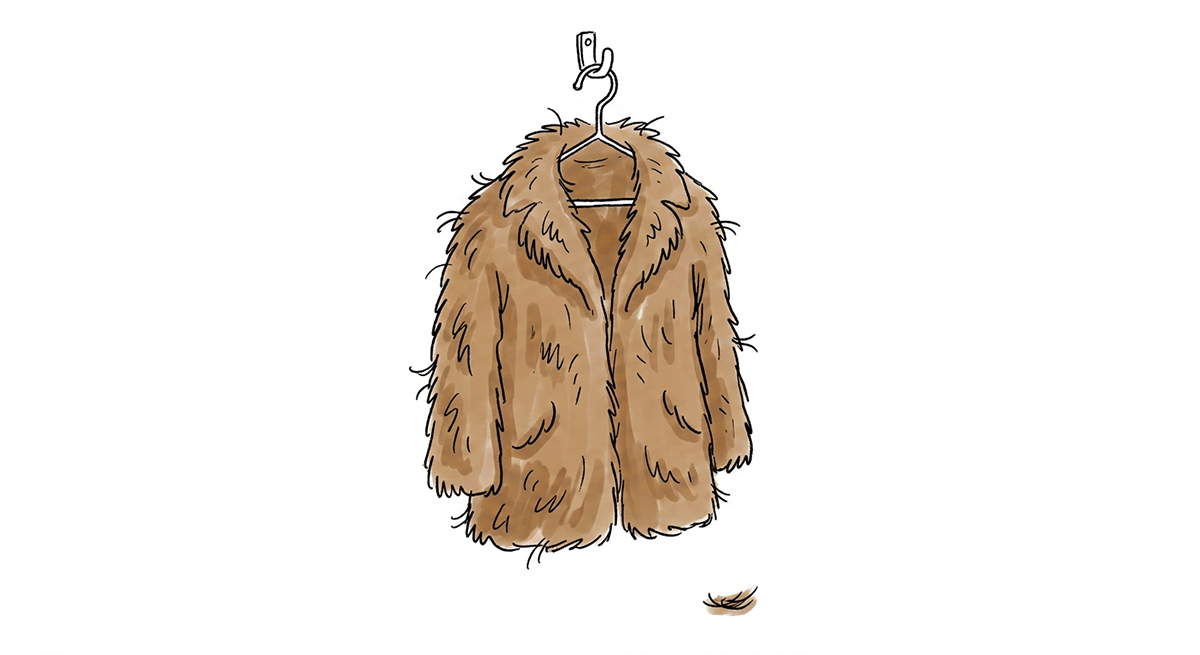
Grandma grew up in Greenwich Village during the early part of the twentieth century. Her father, William, was a furrier and made his little girl fancy fur capes and muffs with scraps left over from coats made for wealthy patrons. He suffered from spells. One day, he had a spell from which he never recovered. Grandma was eight. He left her a love of fur’s rich softness, and these castoff pieces, which she held onto long after her father had died. She proudly wore her monkey fur jacket as she sailed into the Tunnel of Love at Coney Island with her beau at the time, “Stinky Feet” Lanahan. By the time they came out, Stinky Feet was covered in monkey fur, and Grandma’s hair was undone.
After her husband’s death, my great-grandmother worked two jobs, so her children were left on their own. Grandma’s brothers would dare her to go up to the roof of their five-story tenement building and do a chorus-line kick over the edge. With her eyes closed. Just you try and stop me!
I suppose if you had asked anyone in the family if they were poor, they might have shrugged, “Of course, everyone’s poor!” Poverty clung to the background like wallpaper, but out front, on the stoop, were riches. Life was one big block party on Perry Street: her brothers, Willie, the life of the party with his ukulele, and Georgie, who could dance with a stein of beer on his head without spilling a drop. And their mother would clap her hands and laugh just to see her children laughing.
But even with her mother and two brothers working, the small family often couldn’t make the rent, and they moved from East Village to West Village and back again to find an apartment they could afford. Grandma needed a part-time job, and she nervously approached the school principal with her work papers. All Grandma needed was Sister Margaretha’s signature. But Sister glared, “Why don’t you just leave school altogether? None of you—you, your brothers—none of you will ever amount to anything.”
And so she left. She was fourteen and started working right away, first at a switchboard, then later sold ice cream (rattling off all of the flavors some 75 years later). On her first day of work at a hotdog cart, she accidentally spilled mustard all over the back of a woman’s fancy fur coat. Furious, the woman marched Grandma down the sidewalk, demanding to see her boss.
“You should be fired! Who’s going to pay for this, you stupid girl?” Grandma blubbered, her hands covering her face. Grandma turned on the waterworks for maximum effect. Peeking through her fingers, she locked eyes with her boss. Telling you the story, she would show how she peeked, how her eyes were laughing. I don’t know whether they got that mustard off of that coat, but I do know Grandma wasn’t fired from that job.
When I knew her, Grandma had false teeth, like I thought all old people did. Grandma had asked that her dentures be “pearly white,” but her dentist refused, saying they wouldn’t look natural. She had begun losing her teeth at a young age, and one noticeable gap was filled early on with a bright gold tooth, a gift from her boyfriend, later her husband. She loved that gold tooth and took any opportunity she could to flash a smile just so she could show it off.
My mother hated that tooth—was mortified by it. It represented my grandmother in all her poverty and vulgarity. My mother, with her thick glasses and her books clutched tight to her tiny chest. My grandmother, with her perfect figure and her gold tooth. And yet there was so much love between them. Love that burst out and coated anyone who came near with its warmth. The truth is, my mother was Grandma’s favorite.
My mother once told me her favorite childhood memory was hunkering down during air-raid drills during the war. Air raid drills: her favorite childhood memory! A piercing siren would fill the air, and my grandmother would go around turning off the lights in the apartment, going so far as to hide the bedroom alarm clock with its glow-in-the-dark dials under a pillow. She would gather her four children in her bed, some tucking down under the covers, the baby in her arms or at her breast, and she would tell them stories: her stories, her mother’s stories, her mother’s mother’s stories. About dancing on the edge of the tenement roof. About her twin brothers who died, one of measles, and the other of pining. About how she led her three-year-old sister, Mathilde, into Georgie’s bedroom, Georgie sick with scarlet fever, a bowl of ice cream on his nightstand. (“Look, Mathilde! Ice cream!”) How her wild brother Willie would threaten her with a fork until she climbed up onto the kitchen table and sang, “Willie is the greatest!” And how wild Willie, thirty years later, would jump in front of a subway train, thinking he had lost his whole paycheck in a drunken bender. (“You stupid drunk!” Aunt Sophie shrieked, but she was the one who had hidden his wallet away.) And Grossmutter Anna, who only ever wanted to go back to Tcherrmany, Conrad her gardener, angry Sister Margaretha, and Stinky Feet Lanahan in the Tunnel of Love.
In a dark Bushwick apartment, a little girl was listening. And her mother, gazing at her, Oh, my darling daughter, just look at you.


